


February 2026
NewsletterSummary:
-
-
- Current weekly data indicate that the 2025/26 influenza season in Austria is beginning to subside.
- The season’s unusually early onset and intense course — dominated by influenza A H3N2 — placed considerable strain on all areas of the healthcare system.
- Documented influenza vaccinations are approximately 180,000 above last year’s figures; at least moderate vaccine protection is expected despite limited strain match.
- As influenza, common cold-like infections, and COVID-19 are difficult to distinguish clinically, laboratory diagnostics are playing an increasingly important role.
- The Institute of Virology offers PCR testing for influenza A and B (covered by health insurance in the outpatient sector) as well as serological ELISA testing.
-
The most recent weekly influenza detection figures indicate that the current influenza season 2025/2026 is subsiding (Fig. 1).
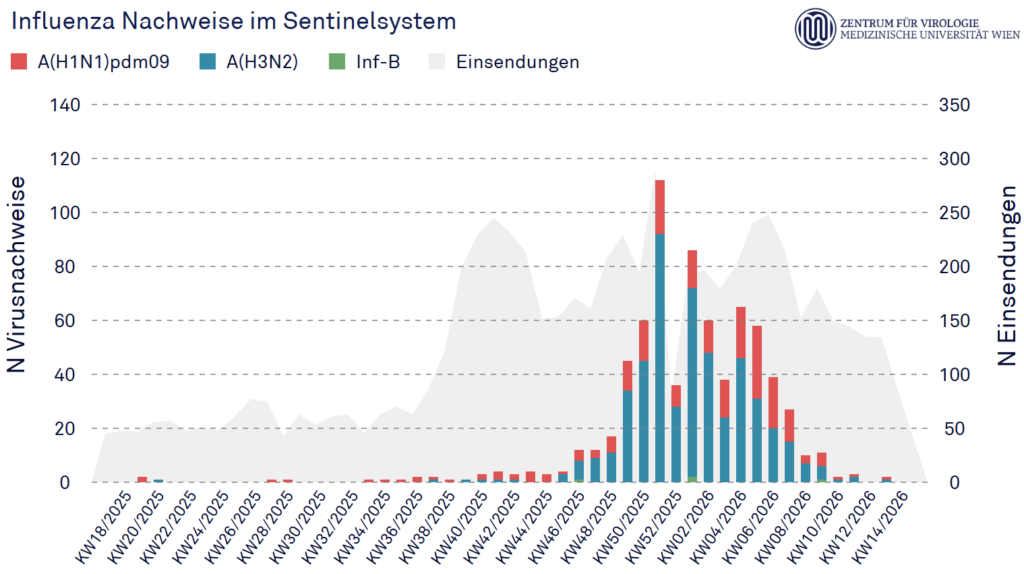
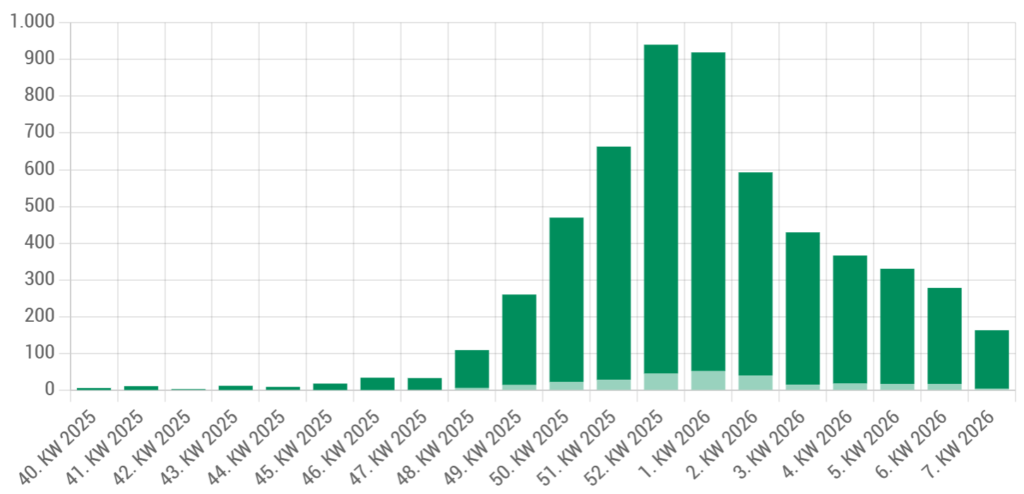
Figure 1. Confirmed positive influenza cases in Austria. Top: Analyses primarily from the private practice sector from calendar weeks 12/25 to 08/26 (sentinel survey) by the Centre for Virology at the Medical University of Vienna (1). Influenza A H3N2 in blue, H1N1 in red. Below: Positive influenza reports to the national SARI dashboard (2) from the hospital sector from calendar weeks 40/25 to 07/26.
An unusually early onset of the high influenza activity phase from CW49–50/2025 and an intense course with marked influenza-associated excess mortality (Fig. 2) posed considerable challenges for the Austrian healthcare system over the past 12 weeks. All areas of care were and continue to be affected — from general practitioners’ practices to hospital outpatient departments through to general and intensive care wards. The infection activity to date has been dominated by the influenza A variant H3N2 (approximately 70%). Influenza A H1N1 accounted for just under 30% (2).
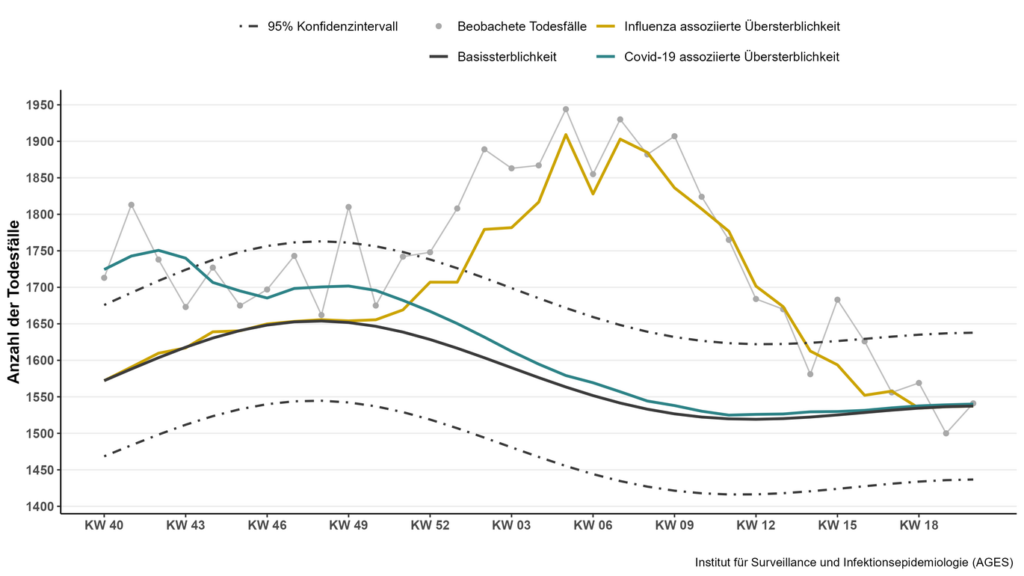
Figure 2. Influenza-associated excess mortality in the winter of 2025/26 (3).
Vaccinations and Prevention
The current vaccine is trivalent, covering H3N2, H1N1, and influenza B (Victoria). According to the Austrian Health Insurance Fund (ÖGK), the number of documented influenza vaccinations is approximately 180,000 above the previous year’s figure, suggesting improved acceptance among the population. The current H3N2 substrain shows 7 mutations compared to last year’s H3N2 strain, on which the current vaccine was based. Despite this limitation in the match between the vaccine and circulating strains, studies indicate at least moderate protection provided by the vaccine (4). Vaccination remains the most important preventive measure to reduce severe illness, hospitalisations, and deaths, and to ease the burden on the healthcare system.
Diagnostics and Differential Diagnoses
Clinical distinction between influenza, common cold-like infections, and COVID-19 based on symptoms alone is only possible to a limited extent, as fever, cough, myalgia, and general malaise can occur in all of these conditions. Against this background, targeted laboratory diagnostics are becoming increasingly important in order to reliably distinguish influenza from other respiratory infections, to guide treatment decisions, and to enable better planning of outbreak management in healthcare facilities. Within our diagnostic range, the Institute of Virology offers a PCR test for influenza A and B, which is also recognised as a health insurance benefit for the outpatient sector. The highly comprehensive respiratory multiplex PCR (“Respi Panel”) with broad coverage of common viral respiratory pathogens, however, is only fully covered in the inpatient setting, while it is unfortunately not yet covered by health insurance in the outpatient sector. In addition to these PCR-based direct pathogen detection methods, the Institute of Virology also offers serological testing by ELISA for influenza A and B.
Links:
- https://viro.meduniwien.ac.at/forschung/virus-epidemiologie-2/ueberwachung-der-zirkulation-respiratorischer-viren-in-oesterreich/influenza-diagnostisches-influenza-netzwerk-oesterreich-dinoe/
- https://www.sari-dashboard.at/
- https://www.ages.at/mensch/krankheit/krankheitserreger-von-a-bis-z/grippe
- https://www.ecdc.europa.eu/en/news-events/early-estimates-seasonal-influenza-vaccine-effectiveness-against-influenza-requiring

Dr.med. Guido Wollmann
guido.wollmann@i-med.ac.at
+43 512 9003 71742